Beyond the Patent Cliff: New Scientific Strategies for Pharmaceutical Lifecycle Innovation

Patent cliffs are typically discussed as an intellectual-property and commercial challenge: exclusivity ends, generic or biosimilar competition enters the market, and pharmaceutical companies seek replacement revenue through new pipeline assets.
But patent cliffs may also present a broader scientific question:
Can new technologies create additional therapeutic and commercial value around established pharmaceutical assets?
Established drugs have something that new molecular entities do not: years of accumulated knowledge regarding safety, pharmacology, manufacturing, clinical response, treatment failure, patient populations, and real-world use.
At Intellicite Labs, we are exploring how new approaches in therapeutic resistance, formulation science, particle behavior, local drug exposure, and biological interaction dynamics could potentially build upon that accumulated knowledge.
Rather than viewing pharmaceutical lifecycle innovation solely as replacing an expiring asset, we are interested in another possibility:
Change the environment, physical behavior, or interactions surrounding an existing therapeutic—and potentially change what that therapeutic can do.
1. Addressing Therapeutic Resistance Through the Tumor Microenvironment
Targeted Modulation of Immunosuppressive Metabolic Conditions in the Tumor Microenvironment
Resistance to cancer therapy does not arise solely from the molecular target of a drug. The tumor microenvironment (TME) can develop metabolic conditions that suppress immune function, support tumor-cell survival, and reduce therapeutic responsiveness.
One patent-pending approach developed by Intellicite Labs explores localized modulation of tumor-associated metabolic conditions as a strategy for enhancing the effectiveness of existing cancer therapies.
The concept addresses a fundamental limitation of systemic metabolic modulation: an agent may be unable to achieve and sustain a sufficiently high concentration within the tumor microenvironment without creating unacceptable systemic exposure.
Targeted delivery could instead enable substantially higher local concentrations capable of crossing functional metabolic or immune thresholds within the tumor.
Ammonia and nitrogen imbalance represent preferred examples, while the broader framework encompasses additional tumor-associated metabolic conditions. Potential applications include combination strategies involving immune checkpoint inhibitors, targeted small-molecule therapies, antibody-based therapies, chemotherapy, and other oncology modalities.
The patent cliff / extending drug lifecycle opportunity: Rather than necessarily replacing an established oncology asset, could addressing a mechanism of therapeutic resistance create new value around that asset?
2. Engineering the Therapeutic Window Through Particle and Excipient Behavior
Particle-Governed Therapeutic Window Systems and Methods for Modulating Drug Exposure
Drug exposure is conventionally understood primarily through administered dose and systemic pharmacokinetics.
But nominal dose may not completely describe what occurs at a biological interface.
A second patent-pending framework explores whether particle size and morphology, aggregation state, surface properties, excipient interactions, tissue microenvironments, and local persistence can influence localized drug exposure—and therefore the boundary between efficacy and toxicity.
The underlying concept is that therapeutic windows may, in some circumstances, represent emergent properties of local exposure rather than fixed properties of nominal molecular dose alone.
This creates an intriguing possibility: modifying therapeutic exposure without necessarily changing the nominal dose.
Formulation and excipient strategies could potentially modify aggregation, dispersion, persistence, or release characteristics to reduce transient local peaks, stabilize exposure, or otherwise influence a therapeutic window.
The framework contemplates applications across multiple drug categories, including immunosuppressive therapies, incretin-based therapies, immune checkpoint therapies, and intravenous antimicrobials.
Figure 1 — Particle–Excipient Interaction. Conceptual illustration of how particle–excipient interactions may modify aggregation behavior and release characteristics, potentially altering local drug exposure without changing nominal dose.

The patent cliff / extendign drug lifecycle opportunity: Could formulation-level control of local exposure improve the efficacy/tolerability relationship of an established therapeutic?
3. Physical Differentiation of Originator and Follow-On Pharmaceutical Products
Shape-Invariant Dissolution Topology, Accessible Surface-Area Equivalence, and Digital-Twin Quantification for Pharmaceutical Powders and Parenteral Reconstitution
Chemical identity does not necessarily describe every physical characteristic of a pharmaceutical formulation.
Particle morphology, micronization, lyophilization, excipient interactions, hydration kinetics, aggregation, and accessible surface area can influence how pharmaceutical materials behave during dissolution and reconstitution.
A third patent-pending framework developed by Intellicite Labs examines pharmaceutical dissolution through accessible surface area (ASA), microstructure topology, hydration dynamics, and digital-twin quantification.
The framework describes reproducible dissolution states ranging from dispersed to weakly associated, flocculated, and networked structures. It further proposes computational and imaging-based methods for converting these behaviors into quantitative topology fingerprints.
This creates potential applications in formulation development, pharmaceutical quality control, lot-to-lot comparison, reconstitution assessment, and originator/follow-on product characterization.
Originator vs. Follow-On Formulation Topology
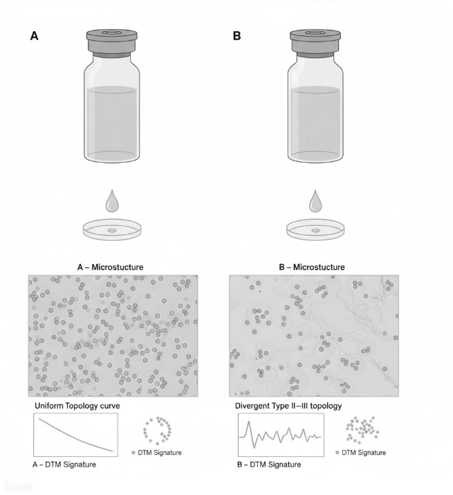
Figure 2a and 2b — Originator vs. Follow-On Formulation Topology. Prophetic example illustrating how outwardly similar formulations may exhibit different dissolution microstructures. Digital-twin analysis generates distinct topology signatures reflecting manufacturing-dependent differences in accessible surface area, hydration, aggregation, and dissolution behavior.

The underlying approach does not depend solely upon chemical composition. Instead, it asks whether the physical behavior of the formulation itself can provide an additional measurable fingerprint.
The lifecycle opportunity: As exclusivity changes, could advanced physical characterization provide new tools for formulation optimization, quality control, comparability, and differentiation?
A Broader Pharmaceutical Innovation Portfolio
These concepts are part of a broader portfolio of patent-pending approaches exploring how physical, chemical, and biological interactions may affect pharmaceutical and therapeutic behavior.
Selected additional concepts include:
Systems and Methods for Modifying Functional Behavior of Particulate Compositions Using Biological Interaction Agents
This work explores modification of particulate behavior through biological interaction agents. Experimental observations submitted as supplemental figures include differences in particulate distribution and air–liquid interface behavior between protein-only preparations and preparations containing a biologically derived interaction agent.
Systems and Methods for Interfacial Charge-Carrier and Chemical-Potential Modulation to Impact Particle Behavior in Fluids
Systems and Methods for Interfacial Proton Modulation to Impact Particle Behavior in Fluids
Systems and Methods for Non-Canonical Enzyme-Mediated Interaction Dynamics of Primary Agents

Figure 3 — Enzyme-mediated interaction acceleration within a targeted anatomical or cellular environment.
Together, these concepts investigate a broader scientific proposition:
Can the functional behavior of a therapeutic or pharmaceutical material be modified not only by changing the active molecule itself, but by controlling its local environment, interfaces, physical state, or interactions?
From Replacement Pipelines to Lifecycle Innovation
Patent expiration will continue to drive pharmaceutical companies toward new pipelines, acquisitions, licensing transactions, and replacement assets.
Those strategies remain essential. But established pharmaceutical assets also represent substantial accumulated scientific knowledge. Clinical development can reveal not only where a therapy succeeds, but where it fails: which patients do not respond, where toxicity emerges, where resistance develops, and where formulation or exposure limitations constrain performance.
Those limitations may themselves become starting points for innovation.
The concepts described here explore several complementary possibilities:
Address the biological environment limiting an existing therapy.
Modify local exposure and the therapeutic window.
Characterize and potentially control the physical behavior of pharmaceutical formulations.
Introduce new biological or interfacial interactions that modify functional behavior.
In each case, the underlying question is similar:
What if lifecycle innovation means not only finding the next drug, but discovering new ways to unlock value from the drugs and pharmaceutical knowledge we already have?
Intellicite Labs is interested in discussions with pharmaceutical and biotechnology companies regarding licensing, co-development, research collaborations, and strategic evaluation of these and related patent-pending concepts.
For partnership and technology-innovation inquiries:[Contact Email]Intellicite Labs


Comments