Formalizing Mechanism-Based Therapeutic Reasoning: The Clinical Origins of MMGPE

Experienced clinicians routinely recognize that patients sharing the same clinical diagnosis often have different underlying biology, disease severity, therapeutic responses, and trajectories. Therapeutic decisions therefore frequently incorporate pathology, biomarkers, organ involvement, disease mechanisms, prior treatment response, and emerging evidence rather than relying on diagnosis alone.
The Multi-Mechanism Guidance and Personalization Platform (MMGPE) was developed to formalize this style of mechanism-based clinical reasoning into a structured computational framework. MMGPE models diseases as networks of interacting biological pathways, evaluates therapeutic coverage, identifies residual mechanistic gaps, and supports pathway-guided prioritization.
This paper discusses the clinical reasoning principles that inspired MMGPE and presents representative examples from dermatology, rheumatology, neurology, and infectious disease. These examples illustrate how mechanism-based thinking is already used in clinical practice and how MMGPE extends it into a scalable framework for precision medicine and translational research.
This paper is also available at:
https://doi.org/10.5281/zenodo.21314654

Figure 1. Clinical specialties that routinely apply mechanism-based therapeutic reasoning in the management of heterogeneous diseases. Representative examples include dermatology, rheumatology, neurology, and infectious disease. This figure is illustrative and does not represent all relevant specialties.
1. Introduction Modern medicine increasingly recognizes that identical clinical diagnoses do not necessarily represent identical biological diseases. Patients with the same diagnosis can differ substantially in dominant pathways, organ involvement, biomarkers, disease severity, and therapeutic response.
Experienced clinicians integrate clinical history, biomarkers, pathology, imaging, prior treatment response, and scientific evidence to guide decisions based on underlying mechanisms rather than diagnostic labels alone. The Multi-Mechanism Guidance and Personalization Platform (MMGPE) was developed to formalize this reasoning into a structured computational framework capable of organizing complex biological information, assessing therapeutic coverage, and supporting personalized prioritization across heterogeneous diseases.
2. Clinical Inspiration The conceptual foundation of MMGPE was inspired by clinical training in dermatology, where therapeutic decision-making in complex inflammatory and autoimmune diseases routinely extends beyond diagnosis to consider dominant immune pathways, pathology, disease severity, and prior treatment response.
This experience highlighted that patients with the same diagnosis often have different underlying biology and may therefore benefit from different therapeutic approaches. These observations motivated the development of a structured computational framework to organize mechanism-based reasoning across diverse diseases. While initially inspired by dermatology, similar reasoning patterns are commonly employed across multiple medical specialties that manage biologically heterogeneous conditions.
3. Representative Clinical Specialties
Dermatology Dermatologists frequently manage complex inflammatory and autoimmune conditions (such as pyoderma gangrenosum, hidradenitis suppurativa, and autoimmune blistering diseases) in which therapeutic choices are guided by dominant immune pathways, pathology findings, and prior treatment response rather than diagnosis alone.
Rheumatology Rheumatologists routinely evaluate patients with autoimmune diseases in which different individuals exhibit varying contributions from B-cell activation, Type I interferon signaling, IL-6 pathways, complement activation, and other mechanisms. This leads to mechanism-informed selection of targeted therapies even among patients with the same diagnosis.
Neurology Neurologists increasingly recognize substantial biological heterogeneity in conditions such as Alzheimer’s disease, multiple sclerosis, and other neurodegenerative and autoimmune disorders. Biomarker, imaging, and molecular data are used to understand dominant mechanisms and guide individualized therapeutic approaches.
Infectious Disease Infectious disease specialists consider not only the pathogen but also host immune responses, inflammation, immune dysregulation, and post-infectious sequelae. Conditions such as Long COVID further illustrate how patients with similar clinical histories can have markedly different dominant biological mechanisms.
4. From Clinical Reasoning to Computational FrameworkMMGPE translates implicit clinical reasoning into an explicit computational workflow:
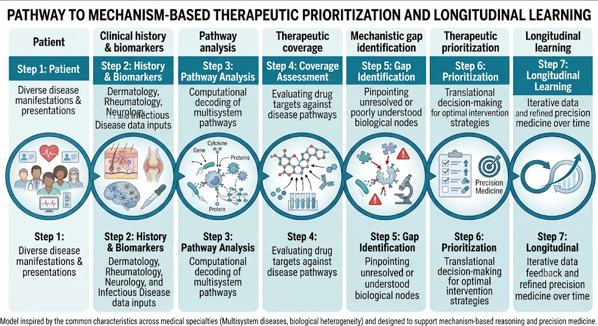
Figure 2. Pathway to Mechanism-Based Therapeutic Prioritization and Computational Framework Patient → Clinical history & biomarkers → Pathway analysis → Therapeutic coverage assessment → Mechanistic gap identification → Therapeutic prioritization → Longitudinal learning
By formalizing this process, MMGPE supports transparency, reproducibility, scalability, and population-level learning while preserving human oversight for final therapeutic decisions.
Discussion Although artificial intelligence has transformed many aspects of biomedical research, the conceptual origins of MMGPE arise primarily from mechanism-based clinical reasoning already practiced by experienced physicians. Rather than replacing clinician expertise, MMGPE organizes this reasoning into a structured framework that can support individualized care, precision medicine, translational research, and therapeutic development.
The examples presented here are representative rather than exhaustive. Mechanism-based therapeutic reasoning is a broadly applicable clinical paradigm used across many medical specialties.
Conclusion MMGPE was inspired by the observation that experienced clinicians routinely think beyond diagnostic labels when managing complex, multisystem diseases. By integrating pathology, biomarkers, organ involvement, therapeutic mechanisms, and longitudinal information, physicians perform sophisticated mechanism-based reasoning that has historically remained largely implicit.
MMGPE formalizes this reasoning into a structured computational framework capable of supporting pathway-guided therapeutic prioritization, precision medicine, and translational research. By transforming expert clinical reasoning into an explicit and reproducible methodology, the platform provides a foundation for more transparent and scalable decision support across heterogeneous diseases.
**Author Perspective The conceptual foundation of MMGPE was inspired by the author’s clinical training in dermatology, where mechanism-based therapeutic reasoning frequently extends beyond diagnosis alone. Similar principles also influenced the development of the EcoExposure™ platform for smartphone-based microplastic and nanoplastic detection. Although these technologies address different domains, both were motivated by the goal of transforming complex reasoning into structured, scalable, and practical frameworks.
Related Intellectual Property This framework supports International Patent Application No. PCT/US26/36347 (filed July 10, 2026) and related U.S. priority applications filed since August 2025.
Papers:
“Multi-Mechanism Guidance and Personalization Engine (MMGPE): A Framework for Complex Disease Optimization and Pathway-Guided Drug Discovery” https://doi.org/10.5281/zenodo.19712359
“Multi-Mechanism Guidance and Personalization Platform (MMGPE): A Computational Framework for Multi-Pathway Disease Modeling, Therapeutic Prioritization, Precision Medicine, and Translational Drug Discovery” https://doi.org/10.5281/zenodo.21305246
MMGPE: Precision Clinical Trial Enrollment An Approach to Minimize Phase II and Phase III Clinical Trial Failure https://doi.org/10.5281/zenodo.21313185
One Framework, Many Users: MMGPE Applications Across Pharma, Clinics, Guidelines, and Patients, A Multi-Mechanism Framework for Stakeholders Across Drug Development, Clinical Translation, Trial Design and Precision Medicine https://doi.org/10.5281/zenodo.21313440
MMGPE vs. General-Purpose Biomedical AI Agents: Differentiating Structured Multi-Mechanism Disease Reasoning from Autonomous Biomedical Research Systems https://doi.org/10.5281/zenodo.21313592
MMGPE: Beyond Conventional AI Drug Discovery (Target-Centric AI) https://doi.org/10.5281/zenodo.21313853
Clinical Applications of MMGPE: Illustrative Examples in Alzheimer's Disease/Dementia, Long COVID, ME/CFS, POTS, Systemic Lupus Erythematosus, and Immune-Related Adverse Events https://doi.org/10.5281/zenodo.21314464
Formalizing Mechanism-Based Therapeutic Reasoning: The Clinical Origins of MMGPE https://doi.org/10.5281/zenodo.21314654
The Single-Model Illusion in AI-Driven Drug Discovery: Introducing a Systems-Level Multi-Model Framework for Translational Discovery



Comments