Exponential Medical Knowledge Growth Does Not Directly Translate to Better AI Drug Discovery

Abstract
The biomedical evidence base is expanding rapidly, and this growth is often assumed to accelerate AI-enabled drug discovery. In practice, the relationship depends on whether new knowledge is usable by a given architecture. A clinical trial, phenotype description, or biomarker association may expand medical knowledge substantially while contributing little to systems whose core tasks depend on protein structures, molecular interactions, or chemical properties.
We define knowledge-growth coupling (KGC) as the degree to which growth in the general biomedical literature can be directly operationalized by a computational architecture, and knowledge applicability rate (KAR) as the proportion of new publications whose principal findings fall within information domains usable by that architecture.
In a random contemporaneous sample of 100 recent PubMed publications evaluated against ten representative drug-discovery architectures, observed KAR ranged from 1% for several specialized structure- and molecularly focused systems to 34% for a biomedical knowledge-reasoning architecture and 41% for the systems-level Multi-Mechanism Guidance and Personalization Engine (MMGPE).
These findings do not measure model quality or drug-development performance. They illustrate that the fraction of general biomedical knowledge growth that is architecture-usable varies substantially. This is because majority of models require a very specific type of data to improve data, not broad scientific or medical knowledge. Claims linking rapid medical knowledge expansion to progress in AI drug discovery should therefore account for this architecture-specific coupling.
This paper is also available at: https://doi.org/10.5281/zenodo.21879879 1. Introduction
Biomedical research produces a continually expanding body of knowledge spanning molecular structure, genetics, cellular biology, immunology, metabolism, pharmacology, biomarkers, clinical phenotypes, therapeutic response, adverse events, epidemiology, and real-world clinical experience. The rapid growth of this evidence base is frequently invoked in discussions of AI-enabled drug discovery. If biomedical knowledge is increasing rapidly and AI systems can process information at scales exceeding the practical capacity of individual researchers, it appears reasonable to infer that expanding medical knowledge should itself accelerate AI-enabled therapeutic discovery.
This inference, however, contains an important unstated assumption:
New biomedical knowledge must be applicable to the computational architecture before that architecture can directly benefit from it.
This condition is not automatically satisfied. Consider a newly published randomized clinical trial demonstrating differential therapeutic response among clinical phenotypes. The study may represent important new medical knowledge. It could influence clinical practice, alter understanding of disease heterogeneity, generate new hypotheses, or identify an inadequately treated patient population. Yet the same publication may contain no new protein structure, ligand-binding measurement, sequence information, molecular interaction data, chemical property measurement, or other information directly usable by a structure-centric molecular model.
Medical knowledge has increased. The information directly usable by that particular computational architecture may not have. Conversely, an architecture representing disease through interacting mechanisms, phenotypes, therapeutic coverage, patient stratification, and residual biological gaps may be able to incorporate the same finding directly into its representation or prioritization process.
A more appropriate representation is:
The distinction becomes increasingly important as AI drug discovery becomes more heterogeneous. Systems commonly grouped under the label “AI drug discovery” perform fundamentally different computational tasks and depend on substantially different information classes. Protein-structure prediction, molecular simulation, generative chemistry, protein generation, phenotypic screening, target identification, knowledge-graph reasoning, and systems-level therapeutic reasoning should therefore not be expected to benefit equally from the same expansion of biomedical knowledge.
This paper introduces knowledge-growth coupling (KGC) as a conceptual framework for examining this relationship and knowledge applicability rate (KAR) as a simple means of measuring one component of it empirically.
Importantly, neither KGC nor KAR is proposed as a measure of AI quality, technological sophistication, commercial performance, clinical success, or probability of producing an approved therapeutic. The framework addresses a narrower question:
To what extent is growth in the general biomedical knowledge base directly relevant to a particular AI drug-discovery architecture?
2. Knowledge-Growth Coupling
2.1 Definition
We define knowledge-growth coupling as:
The degree to which growth in a biomedical knowledge domain can be directly operationalized by a computational architecture through modification of its inputs, representations, inference processes, predictions, or prioritization outputs.
This definition separates two quantities that are frequently treated as equivalent:
Available biomedical knowledge represents the total evidence being generated across biomedical science.
Architecture-usable knowledge represents the subset of that evidence capable of directly affecting a specified computational architecture.

The coefficients αA,i are conceptual rather than empirically established scaling constants. Their purpose is to illustrate why identical increases in the biomedical evidence base may have different consequences for different computational architectures.
For example, an architecture highly coupled to structural biology but weakly coupled to clinical evidence might exhibit:
αstructural >>> αclinical
while a systems-level translational architecture could exhibit meaningful coupling across several knowledge domains simultaneously.
The relationship is not:

A more appropriate representation is:

Figure 2. Differential knowledge-growth coupling across drug-discovery architectures. Conceptual comparison illustrating why growth in the general biomedical evidence base may have limited direct applicability to narrow structure-centric models, whose core inputs depend primarily on specialized structural, sequence, and biophysical data, while systems-level multi-mechanism frameworks can incorporate heterogeneous basic, translational, clinical, cross-specialty, and real-world evidence. MMGPE is shown as an illustrative preliminary systems-level architecture in which expanding knowledge can update mechanism networks, residual-gap detection, patient stratification, and therapeutic prioritization.
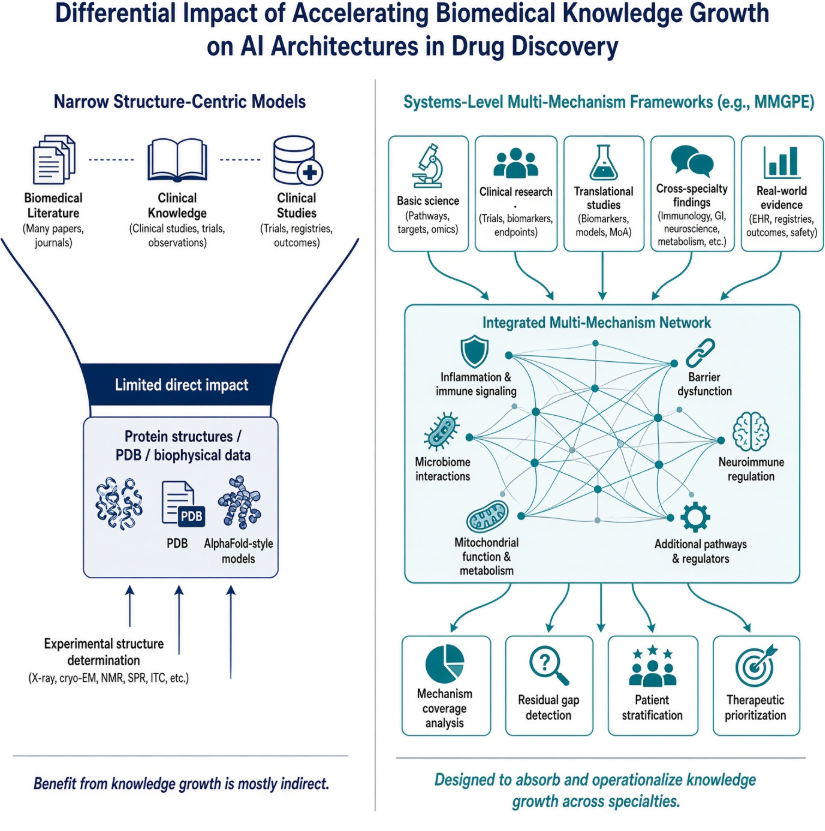
Potential domains include:
The coefficients are conceptual rather than empirically established scaling constants. Their purpose is to illustrate why identical increases in the biomedical evidence base may have different consequences for different computational architectures.
For example, an architecture highly coupled to structural biology but weakly coupled to clinical evidence might exhibit: while a systems-level translational architecture could exhibit meaningful coupling across several knowledge domains simultaneously.
The central principle can therefore be stated simply:
An architecture benefits directly from general biomedical knowledge growth only to the extent that it is coupled to the domains in which that growth occurs.
3. Knowledge Applicability Rate
Knowledge-growth coupling is a conceptual architectural property. One component of this relationship can be operationalized directly at the publication level.
For publication and architecture , define an applicability indicator:
The Knowledge Applicability Rate (KAR) for architecture is:
or, expressed as a percentage:

For a sample containing 100 publications, every directly applicable publication corresponds to one percentage point of KAR.
KAR asks a deliberately narrow question:
What proportion of newly generated biomedical publications contains principal findings that fall within information domains directly usable by a specified computational architecture?
KAR does not measure predictive accuracy, technological sophistication, drug-development success, model quality, commercial value, or the magnitude of improvement produced by an individual publication.
A highly specialized model could have a very low KAR while being exceptionally capable at its intended task.
KAR instead measures the breadth of the general biomedical evidence stream to which an architecture is directly coupled.
4. Defining Direct Applicability
A meaningful applicability analysis requires a criterion established independently of the observed results.
For the present framework, a publication is considered directly applicable when:
The principal new information reported in the publication falls within an information domain capable of directly modifying the evaluated architecture's input, representation, inference, prediction, or prioritization.
Otherwise, the publication is classified as not directly applicable.
This intentionally differs from asking:
Could somebody working at the company find this paper useful?
Under such a broad definition, almost any biomedical publication could potentially provide background information, inspire a hypothesis, influence research strategy, or inform a scientist.
That is not the relationship being measured. The unit of analysis is the computational architecture, not the organization as a whole. For example, a clinical study demonstrating that one patient phenotype responds differently to an existing therapy could be highly relevant to an organization's drug-development strategy while supplying no new information directly applicable to a protein–ligand interaction model. Likewise, a newly determined protein structure may directly affect a structure-based design architecture while having comparatively limited immediate effect on a system focused on population-level clinical treatment response.
The binary definition is intentionally simple and conservative for the purposes of this analysis.
5. Representative Drug-Discovery Architectures
The contemporary AI drug-discovery landscape includes architectures with substantially different information dependencies. Ten representative approaches were used to illustrate this range.
Representative Platform | Architecture | Principal Information Domain |
Isomorphic Labs | Structure-informed molecular design | Protein structure, sequence, binding and molecular interaction |
Schrödinger | Physics-based and ML molecular modeling | Molecular structure, binding, chemical properties and physical simulation |
Atomwise | Structure-based deep learning | Protein targets and protein–ligand interactions |
Generate:Biomedicines | Generative protein design | Protein sequence, structure, function and experimental protein data |
XtalPi | AI, physics and computational chemistry | Molecular structure, chemical properties, binding and synthesis |
Recursion | Phenotypic ML | Cellular morphology, perturbational biology and phenotypic assays |
insitro | Multimodal biological ML | Genetics, cellular phenotypes, imaging and clinical cohorts |
Insilico Medicine | Target discovery and generative chemistry | Disease biology, omics, targets, molecular design and development data |
BenevolentAI | Biomedical knowledge reasoning | Literature-derived relationships, pathways and knowledge graphs |
MMGPE | Systems-level multi-mechanism reasoning | Mechanisms, phenotypes, treatment response, therapeutic coverage, residual gaps and stratification |
These organizations are not assumed to operate only the architectures summarized above.
Commercial platforms may include multiple models, proprietary datasets, internally generated experimental data, specialized databases, and analytical systems that are not publicly described.
Accordingly, the comparison evaluates representative architectural approaches, not the total capabilities or performance of individual companies.
This distinction is particularly important for broader platforms incorporating literature mining, multimodal biological information, or internally generated datasets.
6. MMGPE as a Systems-Level Architecture
The Multi-Mechanism Guidance and Personalization Engine (MMGPE) provides an illustrative example of an architecture designed around heterogeneous biomedical evidence. MMGPE is currently a preliminary systems-level framework and is included here to examine the knowledge-growth properties of its proposed architecture, not to imply demonstrated performance relative to established commercial drug-discovery platforms.
Rather than representing disease solely through a single target or molecular interaction, MMGPE represents disease as a network of interacting mechanisms contributing to a phenotype.
A simplified representation is:
This creates multiple potential entry points for newly generated biomedical knowledge.
· A basic-science study may identify or refine a disease mechanism.
· A translational study may establish relationships between a mechanism and a particular phenotype.
· A biomarker study may improve patient stratification.
· A clinical trial may change evidence regarding the effectiveness of an intervention against a particular disease component.
· A treatment-failure study may identify persistent residual mechanisms.
· A safety study may alter the feasibility of an otherwise mechanistically attractive therapeutic strategy.
Research originating in another specialty may identify a mechanism that has received insufficient attention within the disease being modeled. Thus, the architecture is designed such that heterogeneous biomedical findings can potentially modify its disease representation or therapeutic prioritization. This does not establish that MMGPE performs better than specialized architectures. It establishes a different property: MMGPE is designed to have relatively broad coupling to heterogeneous biomedical knowledge domains.
7. Empirical Evaluation Using Recent PubMed Publications
7.1 Study Design
To determine whether knowledge applicability can be measured empirically, a contemporaneous sample of 100 recent PubMed-indexed records was obtained programmatically.
Using a time-defined sample rather than investigator-selected publications reduces the opportunity to preferentially select studies favorable to a particular architecture. Each publication represented one unit of analysis. Each publication was evaluated against each of the ten representative architectures.
This produced:
Each architecture-publication pair received a binary score: The primary analysis was descriptive.
The 100-publication sample is not intended to precisely estimate the long-term composition of the entire biomedical literature. Rather, it provides a contemporaneous empirical test of whether equivalent growth in the general biomedical evidence base produces equivalent amounts of directly applicable information across computational architectures.
8. Results
Direct knowledge applicability varied substantially across the ten computational architectures.
The lowest Knowledge Applicability Rates were observed among the most structurally and molecularly specialized architectures. The architecture classes represented by Isomorphic Labs, Schrödinger, Atomwise, and Generate:Biomedicines each had a KAR of 1% (1/100).
The broader computational chemistry architecture represented by XtalPi had a KAR of 4% (4/100).
Applicability increased among architectures incorporating broader biological information domains. The phenotypic machine-learning architecture represented by Recursion had a KAR of 10% (10/100), while the multimodal biological architecture represented by insitro had a KAR of 14% (14/100).
The target-discovery and generative platform represented by Insilico Medicine had a KAR of 15% (15/100).
The biomedical knowledge-reasoning architecture represented by BenevolentAI had a substantially higher KAR of 34% (34/100).
MMGPE, representing a preliminary systems-level multi-mechanism architecture incorporating mechanistic, translational, therapeutic, phenotypic, and clinical evidence, had the highest observed applicability rate at 41% (41/100).
Table 1. Knowledge Applicability Rate Across Representative Architectures
Representative Architecture | Applicable | Not Applicable | KAR |
Isomorphic Labs | 1 | 99 | 1% |
Schrödinger | 1 | 99 | 1% |
Atomwise | 1 | 99 | 1% |
Generate:Biomedicines | 1 | 99 | 1% |
XtalPi | 4 | 96 | 4% |
Recursion | 10 | 90 | 10% |
insitro | 14 | 86 | 14% |
Insilico Medicine | 15 | 85 | 15% |
BenevolentAI | 34 | 66 | 34% |
MMGPE | 41 | 59 | 41% |
Across the same contemporaneous stream of 100 biomedical publications, the proportion containing information classified as directly applicable therefore ranged from 1% to 41%, depending on architecture.
The overall pattern was: as architectures progressed broadly from specialized structural and molecular representations toward increasingly heterogeneous biological, literature-derived, and systems-level evidence integration.
The relatively high applicability observed for BenevolentAI is particularly informative. Broad knowledge applicability was not unique to MMGPE. Instead, an established knowledge-reasoning architecture also exhibited substantially greater applicability than narrowly specialized architectures.
This pattern is consistent with knowledge-growth coupling being an architecture-level phenomenon rather than an MMGPE-specific property.

Figure 1. Knowledge Applicability Rate (KAR) across representative drug-discovery architectures. KAR represents the percentage of a contemporaneous sample of 100 PubMed-indexed publications whose principal findings could be directly operationalized by each architecture. Observed KAR ranged from 1% for specialized molecular systems to 41% for the systems-level MMGPE framework. The accompanying equation defines knowledge-growth coupling (KGC) across incremental biomedical knowledge domains.
9. Why Medical Knowledge Growth and AI Improvement Are Not Equivalent
The distinction between total and architecture-usable knowledge has implications for commonly made predictions about AI drug discovery.
The biomedical literature can expand dramatically while the subset of information directly usable by a particular architecture expands far more slowly.
In this sample, a 100-publication increase in the biomedical literature yielded only one directly applicable paper for several specialized structure- and molecularly focused architectures, versus 34 for a knowledge-reasoning system and 41 for the systems-level multi-mechanism framework—a more than 40-fold range in knowledge applicability to the same nominal growth in the literature.
This is a measure of applicability, not of technological capability. Specialized architectures can (and do) improve rapidly through better structural data, proprietary experiments, larger sequence databases, physical simulation, self-distillation, and architectural advances. Those routes remain
powerful. They are simply not the same as the general expansion of medical knowledge.
The practical implication is straightforward: teams can use knowledge-growth coupling and knowledge applicability rate to diagnose where their systems are currently blind to large parts of the biomedical literature, and to decide deliberately whether broader coupling would improve prioritization, gap detection, or discovery hypotheses.



Comments